Designing an AI workshop for teachers, and prototyping it live.
Enhancing Learning Experiences with AI is a one- to two-day workshop for teachers who are curious about AI but would not call themselves technical. This page is how it was designed, and how I tested it: the context map and learning outcomes that came first, the study that redirected the brief halfway through, the twenty-minute prototype I ran in front of a room, and what came back.
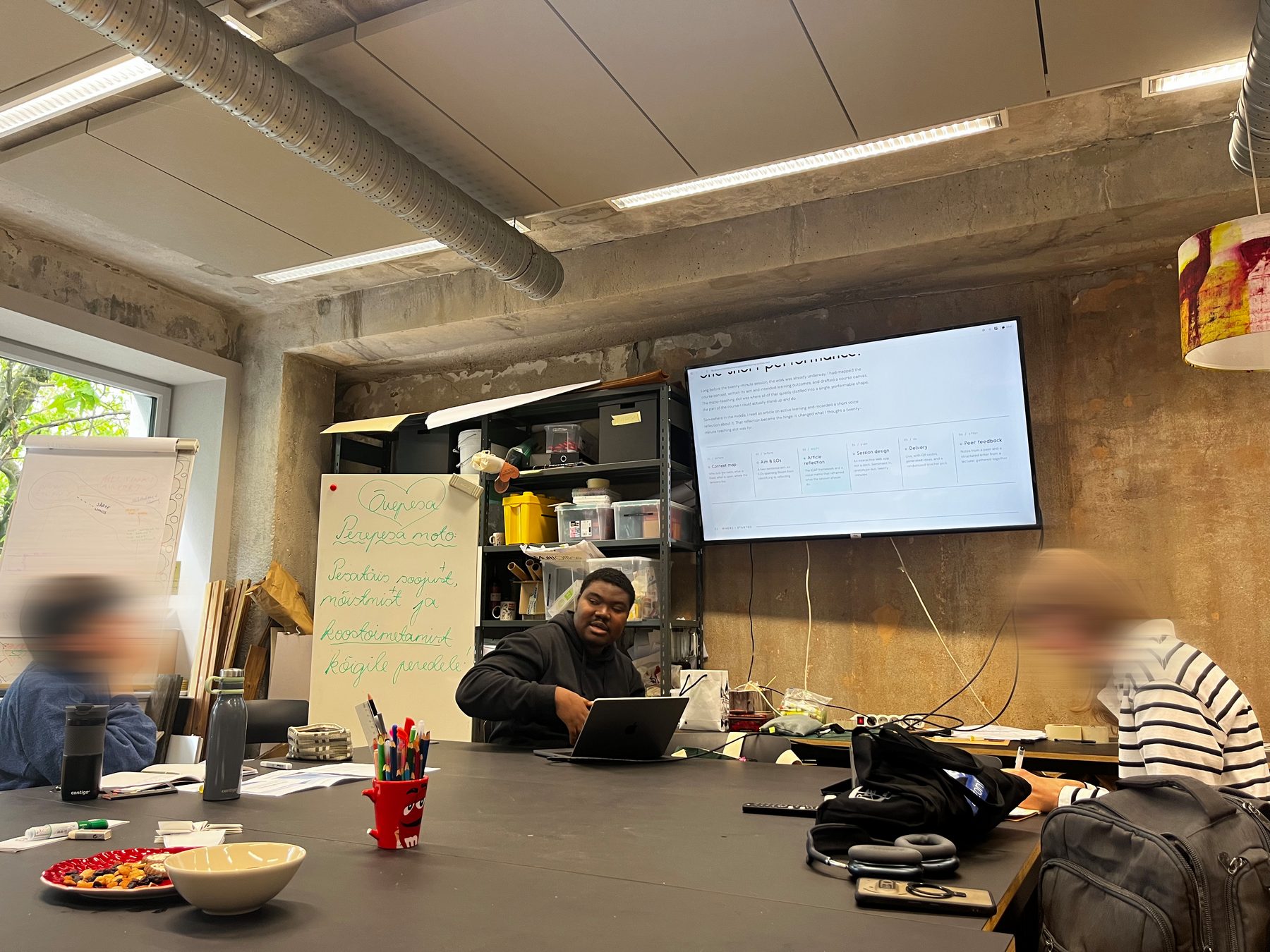 In the room · 30 April 2026
Six pieces of thinking that came before the room.
Long before the twenty-minute session, the work was already underway. I had mapped the course context, written its aim and intended learning outcomes, and drafted a course canvas. The micro-teaching slot was where all of that had to condense into something performable: the part of the course I could actually stand up and do.
Somewhere in the middle, I read an article about how studio-art teachers in higher education actually assess student work, and recorded a short voice reflection about it. That reflection became the hinge: it changed what I thought a twenty-minute teaching slot was for.
The context map made the constraints visible.
The course I am designing is a one to two day workshop for teachers who are curious about AI but do not see themselves as technical experts. Before I could plan a twenty-minute taste of it, I had to map the situation: a small group of five to eight participants from mixed institutions, with AI experience ranging from never used to daily, attitudes ranging from curious to skeptical, and each one returning to a different institutional culture afterwards.
The map made one thing clear: the workshop must hold space for both the enthusiasts and the resisters, and it cannot pretend to deliver mastery in two days. What it can deliver is one good prototype each, plus the confidence to keep going.
Three things I wanted the session to do.
A micro-teaching session is a strange object. It is too short to teach anything in depth, and too long to be merely a demonstration. I decided to treat it as a condensed prototype of the workshop itself: a small, complete arc that participants could walk into curious and walk out of having seen, felt, and tried something. The session needed to do three things at once.
The medium is the message.
Voting is teaching.
Magicians rehearse.
Halfway through, a study about studio teachers redirected the brief.
I recorded the reflection as a voice memo rather than a written note, because I wanted to catch the unfinished thinking: the moment something shifts before it has become an argument. What surfaced was that the article was not really telling me about AI. It was telling me about who is in the room.
The study describes a specific kind of professional. They are accomplished in their practice. They were trained to make work, not to teach it. They inherit a vocabulary, rubrics, intended learning outcomes, criteria, that often feels borrowed from elsewhere. And underneath the inherited vocabulary, what most of them actually use to judge a student's work is intuition: a gestalt formed through years of making and looking. The article is honest about this. It also notes that there is rarely a departmental conversation in which this can be said out loud.
That reframed the workshop for me. Its job is to make a small, well-supported space where teachers can talk about teaching at all, with AI as the pretext and the playground. The session should not perform mastery. It should make room for the same ambiguity, experiment and failure-tolerance that studio teachers already work inside, and treat AI as another tool that produces ambiguous, sometimes useful, sometimes irrational output: a creative partner in the same mode as the practice itself.
No slides. One live web app, one room.
Instead of slides, the session ran inside a single Next.js app deployed to Vercel. Participants scanned a QR code on their phones to vote and submit; the host screen showed the live aggregation, the generated ideas, and the final build. The full session is embedded below.
Inside the session.
The session did what it tried to do.
- Structure was visible. Slides had timeframes, roles were clarified at the start, the arc was readable.
- Voting created a fast read of the room. The opening sentiment vote turned twenty strangers into a measurable group in under two minutes.
- The mid-session storytelling pivot. Leaning back from the laptop and speaking freely changed the pace and gave the room permission to listen rather than do.
- The emotions wheel found a new context. A familiar tool used in an unfamiliar way reframed it for a colleague in the room.
- The live build landed. The prototype assembled in time. The room saw a working artefact emerge from a teacher's one-sentence brief.
Where the next iteration should put its weight.
- Designed questions, not improvised ones. When time allows, prepare specific whole-class and small-group prompts in advance, to manage timing while still leaving room for spontaneous threads.
- The EKA GPT for ILOs. The lecturer's letter pointed out that EKA has a GPT tool that goes from course description to ILOs. My demo went in the reverse direction. Worth connecting the two.
- Posture as pedagogy. The lecturer noticed the moment I stepped back from the screen. I want to make that shift in posture and pace a deliberate move, not an accident.
- A graceful fallback path. The Lovable build worked. Next time I want a pre-baked fallback ready, so a technical hiccup costs five seconds, not five minutes.
- Closing the loop more slowly. The final two minutes were tight. The closing comparison deserves room to breathe.
Two voices, two registers.
After the session I received feedback in two different forms. A peer took live notes during the session, capturing the moment-to-moment observations as they happened. The lecturer sent a structured letter afterwards, written in the describing, interpreting, relating form we have been practicing in class. I have kept both in their original shape. The difference in register is the interesting part: the same twenty minutes, read from two very different places in the room.
Read live, not later.
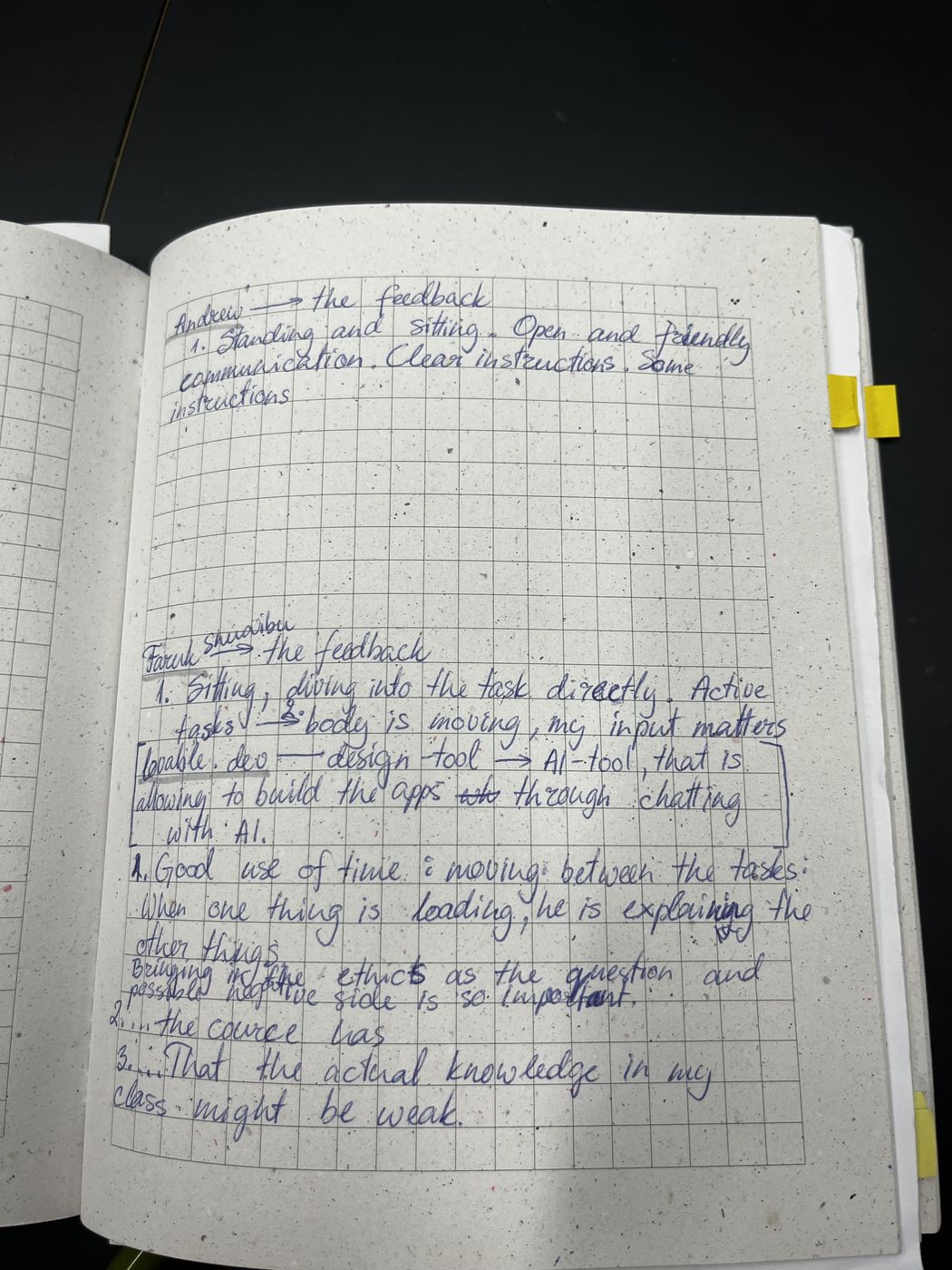
The note is short and made on the fly: a few numbered observations under the heading Faruk Shuaibu › the feedback. What I read in it is a particular way of looking. The observer was tracking the choreography of the session, posture, sequencing, the use of waiting time, more than any single argument I was trying to make. The form of the session, then, was doing visible work.
The note also flags two open prompts (2. ...the course has, 3. ...that the actual knowledge in my class might be weak) that read like questions held in the air rather than conclusions. I value them precisely because they are not resolved.
- Posture and pace. Sitting, then diving into the task directly. Active tasks. "Body is moving, my input matters."
- The tool, named. Lovable.dev as a design tool, an AI tool that lets you build apps through chatting with AI.
- Use of time. Moving between tasks well, when one thing is loading, explaining the next.
- The ethical question landed. Bringing in ethics as the question, and the possible negative side, was noted as important.
- An unfinished prompt. "...the course has —" a question left open about what the workshop carries with it.
- A self-directed worry. "...that the actual knowledge in my class might be weak" — an observation the peer was reflecting back onto their own practice, not mine.
Dear Faruk,
I'm sending my feedback on the micro-teaching session. It loosely follows the same structure we used in class: describing, interpreting, and then relating it back to myself. If anything is unclear or if you'd like me to expand on something, just let me know, I'd be happy to.
Your teaching session had a very clear structure, with the introductory interactive activity at the beginning, followed by the main content, and later a conclusion with a short reflective task. You used digital tools (instead of paper and pen) to engage participants, which made it possible to quickly gather and see the group's overall attitudes toward the topic. The slides had a timeframe, which helped us understand how long and how deeply we were expected to engage with the topic.
You explained what we were going to do and clarified your role. Since participants had to write down the objectives of their own course, this activity also helped us step into our own roles. The task about our attitudes and writing the ILOs gave us time to transition from the previous topic and focus on the current one. Overall I believe you balanced the technical and more serious aspects of the topic very well with a fun and interactive activity, allowing space for both.
I noticed a shift in your behaviour in the middle of the session when you were explaining how AI tools can be useful in large lecture settings. The situation made me think of storytelling. You leaned back a little from the computer and spoke freely, which signaled that we can listen and focus our attention on you. It changed the pace and made your micro-teaching session more dynamic.
We also had an open and critical discussion, which you helped to further develop and connected back to the industry for a broader context. In the future when you have more time, you could think about what kinds of questions, either for the whole class or as a smaller group task, could help generate this kind of discussion. A small group task allows you to manage time more precisely, while a whole-group discussion works well in a setting where participants feel safe and can spontaneously bring in new ideas.
When you showed how the ILOs we wrote could be used to generate learning activities, it made me think about how EKA has a GPT tool for teaching staff to help formulate ILOs from course descriptions, and why it might be useful to also approach this the other way around.
The way you used the emotions wheel made me reflect on myself as a teacher that I've used it before in another context, but it hadn't occurred to me that the wheel could be used in this way. Thank you for showing me this possibility.
Best regards.
Thank you.
The micro-teaching session is a rehearsal, not the workshop. What it gave me is harder to put on a slide: a felt sense of how the workshop wants to move, where it slows down, where it asks for hands, where it asks for silence.
The next pass at this course will not start from the slides. It will start from this twenty minutes, asking which parts deserve to grow, and which were honest only because they were short.
Designed and delivered solo. Documented as part of the EKA Learning & Teaching in University course portfolio, May 2026.